

.png)
Students representing more than 40 countries graduated this week from Minerva University in San Francisco, preparing to launch careers and ventures across AI, climate-tech, sustainability, entrepreneurship, and global business.
At the university’s 2026 Degree Conferral Ceremony, commencement speaker Adam Met, member of the multi-platinum band AJR and founder of Planet Reimagined, encouraged graduates to resist defining themselves by a single identity or career path.
Reflecting on childhood ambitions, Met noted how people are often taught to define themselves through a single role or title. Referencing Oscar Wilde’s idea of being a “verb” rather than a “noun,” Met encouraged graduates to think more expansively about identity and purpose.
Met spoke about spending more than two decades building a music career with his brothers before eventually achieving his childhood dream of headlining Madison Square Garden. Along the way, he said, he realized the lessons he learned through music could extend far beyond the stage.
“One of the things that is so important to me in life, when you’re in school studying one thing, it doesn’t mean you’re just studying one thing,” Met said.
That mindset eventually led him to climate advocacy and social impact work. Leveraging concepts he learned while building a fan community through music, Met described the concept of “collective effervescence,” the idea that when people come together around a shared purpose, their energy and thinking begin to align in powerful ways. “I took the idea of collective effervescence and applied it to climate and social justice,” Met said.
Throughout his remarks, Met returned repeatedly to the idea that identity should remain expansive, evolving, and multidimensional. “It’s one of the reasons why I love Minerva so much, because you don't just study in one place, you don't just do one thing.”
.png)
Met also reflected on how his conversations and collaborations with Minerva students had shaped his own perspective, saying their ideas and approach to the world often inspired him to carry new thinking back into his own work.
Closing his remarks, Met encouraged graduates to resist narrow definitions of success and identity, arguing that people should not feel pressured to define themselves through a single role, title, or path.
Reflecting on the common question of what someone wants to “be” when they grow up, Met challenged graduates to think beyond simple labels and instead consider the fuller picture of who they are as people.
“Why couldn’t it be a sentence?” Met asked. “Why couldn’t I be a sentence that incorporates nouns, verbs, emotion, love?”
Met closed by telling graduates he admired the ways they were already applying those ideas in the world around them. “There are so many different kinds of love,” Met said. “I love everything that you all are doing for the world and in the world.”
“So ultimately, when I think about what I want to be when I grow up, and when you all think about what you want to be when you grow up, don't just share a noun, don't just share a verb, but share a sentence,” Met said. “Be something more than one thing, because you all already are. Go out in the world and be a sentence.”
Minerva University President Mike Magee echoed similar themes throughout his remarks, reflecting on the interconnected nature of the Minerva community and the responsibilities that come with a global education.
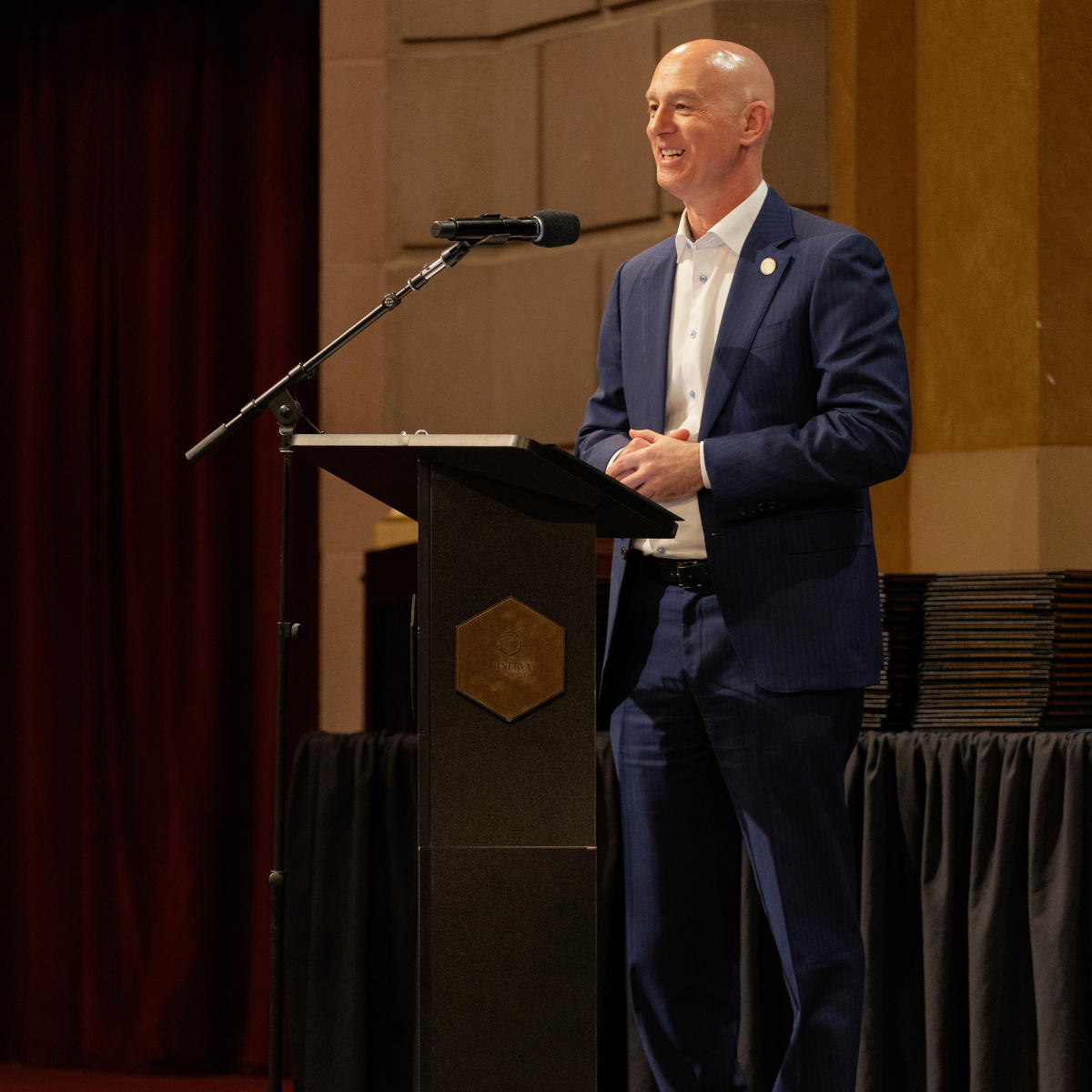
“When conflict breaks out anywhere in the world, it affects the Minerva community in a very deep way,” Magee said. “We always have classmates and family and friends who are affected when there is conflict in the world.”
Magee reflected on how students’ experiences living and learning across countries had prepared them to navigate complexity, uncertainty, and collaboration across cultures.
“You are already so much better prepared for a global future,” Magee said. “What you’ve learned during your time at Minerva, in your classes and projects, collaborating with each other, has prepared you so well for the next steps in your lives and careers.”
He also highlighted the global scope of student capstone projects, which addressed challenges ranging from drought in South Africa and intimate partner violence in Rwanda to economic connectivity in New York and San Francisco, justice systems in Brazil, and culture-building at the intersection of art and technology.
“These are the kinds of problems that need to be solved if we’re going to build a safe, sustainable, just future together,” Magee said.
Closing the ceremony, Magee reflected on a Ralph Waldo Emerson quote he first shared with students during Convocation four years earlier.
“There is no end in nature, but every end is a beginning,” Magee said, paraphrasing Emerson. “This is the end of one part of your Minerva journey, but very much the beginning of another.”
As graduates crossed the stage and officially joined Minerva’s alumni community, the ceremony returned repeatedly to the theme that global citizenship is not simply about where students traveled, but how they learned to live, collaborate, and build community across borders.
“You’re joining our alumni community,” Magee told graduates. “You’re making the circle of that alumni community much larger, and you’re enriching that community.”
–
Watch the full 2026 Minerva University Degree Conferral Ceremony here and learn more about the global educational experience that shaped this year’s graduating class here.
Quick Facts
Computational Sciences
Natural Sciences
Computational Sciences
Arts & Humanities, Natural Sciences
Social Sciences & Arts and Humanities
Business
Computational Sciences
Computational Sciences
Social Sciences & Business
Computational Sciences
Social Sciences
Computational Sciences & Business
Business & Computational Sciences
Computational Sciences
Computational Sciences
Social Sciences & Business
Business
Natural Sciences
Social Sciences
Social Sciences
Social Sciences & Business
Business & Computational Sciences
Business and Social Sciences
Social Sciences and Business
Computational Sciences & Social Sciences
Computer Science & Arts and Humanities
Business and Computational Sciences
Business and Social Sciences
Natural Sciences
Arts and Humanities
Business, Social Sciences
Business & Arts and Humanities
Computational Sciences
Natural Sciences, Computer Science
Computational Sciences
Arts & Humanities
Computational Sciences, Social Sciences
Computational Sciences
Computational Sciences
Natural Sciences, Social Sciences
Social Sciences, Natural Sciences
Data Science, Statistics
Computational Sciences
Business
Computational Sciences, Data Science
Social Sciences
Natural Sciences
Business, Natural Sciences
Business, Social Sciences
Computational Sciences
Arts & Humanities, Social Sciences
Social Sciences
Computational Sciences, Natural Sciences
Natural Sciences
Computational Sciences, Social Sciences
Business, Social Sciences
Computational Sciences
Natural Sciences, Social Sciences
Social Sciences
Arts & Humanities, Social Sciences
Arts & Humanities, Social Science
Social Sciences, Business
Arts & Humanities
Computational Sciences, Social Science
Natural Sciences, Computer Science
Computational Science, Statistic Natural Sciences
Business & Social Sciences
Computational Science, Social Sciences
Sustainability
Sustainability
Natural Sciences & Sustainability
Natural Sciences
Sustainability
Computational Sciences
Computational Sciences
Computational Science & Business
Data Science and Statistics, Digital Practices
Earth and Environmental Systems
Cognition, Brain, and Behavior & Philosophy, Ethics, and the Law
Computational Theory and Analysis
Computer Science and Artificial Intelligence
Brand Management & Computer Science and Artificial Intelligence
Computer Science and Artificial Intelligence
Economics and Society & Strategic Finance
Enterprise Management
Economics and Society
Cells and Organisms & Brain, Cognition, and Behavior
Cognitive Science and Economics & Political Science
Applied Problem Solving & Computer Science and Artificial Intelligence
Computer Science and Artificial Intelligence & Cognition, Brain, and Behavior
Designing Societies & New Ventures
Strategic Finance & Data Science and Statistics
Brand Management and Designing Societies
Data Science & Economics
Machine Learning
Cells, Organisms, Data Science, Statistics
Arts & Literature and Historical Forces
Artificial Intelligence & Computer Science
Cells and Organisms, Mind and Emotion
Economics, Physics
Managing Operational Complexity and Strategic Finance
Global Development Studies and Brain, Cognition, and Behavior
Scalable Growth, Designing Societies
Business
Drug Discovery Research, Designing and Implementing Policies
Historical Forces, Cognition, Brain, and Behavior
Artificial Intelligence, Psychology
Designing Solutions, Data Science and Statistics
Data Science and Statistic, Theoretical Foundations of Natural Science
Strategic Finance, Politics, Government, and Society
Data Analysis, Cognition
Conversation
Students representing more than 40 countries graduated this week from Minerva University in San Francisco, preparing to launch careers and ventures across AI, climate-tech, sustainability, entrepreneurship, and global business.
At the university’s 2026 Degree Conferral Ceremony, commencement speaker Adam Met, member of the multi-platinum band AJR and founder of Planet Reimagined, encouraged graduates to resist defining themselves by a single identity or career path.
Reflecting on childhood ambitions, Met noted how people are often taught to define themselves through a single role or title. Referencing Oscar Wilde’s idea of being a “verb” rather than a “noun,” Met encouraged graduates to think more expansively about identity and purpose.
Met spoke about spending more than two decades building a music career with his brothers before eventually achieving his childhood dream of headlining Madison Square Garden. Along the way, he said, he realized the lessons he learned through music could extend far beyond the stage.
“One of the things that is so important to me in life, when you’re in school studying one thing, it doesn’t mean you’re just studying one thing,” Met said.
That mindset eventually led him to climate advocacy and social impact work. Leveraging concepts he learned while building a fan community through music, Met described the concept of “collective effervescence,” the idea that when people come together around a shared purpose, their energy and thinking begin to align in powerful ways. “I took the idea of collective effervescence and applied it to climate and social justice,” Met said.
Throughout his remarks, Met returned repeatedly to the idea that identity should remain expansive, evolving, and multidimensional. “It’s one of the reasons why I love Minerva so much, because you don't just study in one place, you don't just do one thing.”
Met also reflected on how his conversations and collaborations with Minerva students had shaped his own perspective, saying their ideas and approach to the world often inspired him to carry new thinking back into his own work.
Closing his remarks, Met encouraged graduates to resist narrow definitions of success and identity, arguing that people should not feel pressured to define themselves through a single role, title, or path.
Reflecting on the common question of what someone wants to “be” when they grow up, Met challenged graduates to think beyond simple labels and instead consider the fuller picture of who they are as people.
“Why couldn’t it be a sentence?” Met asked. “Why couldn’t I be a sentence that incorporates nouns, verbs, emotion, love?”
Met closed by telling graduates he admired the ways they were already applying those ideas in the world around them. “There are so many different kinds of love,” Met said. “I love everything that you all are doing for the world and in the world.”
“So ultimately, when I think about what I want to be when I grow up, and when you all think about what you want to be when you grow up, don't just share a noun, don't just share a verb, but share a sentence,” Met said. “Be something more than one thing, because you all already are. Go out in the world and be a sentence.”
Minerva University President Mike Magee echoed similar themes throughout his remarks, reflecting on the interconnected nature of the Minerva community and the responsibilities that come with a global education.
“When conflict breaks out anywhere in the world, it affects the Minerva community in a very deep way,” Magee said. “We always have classmates and family and friends who are affected when there is conflict in the world.”
Magee reflected on how students’ experiences living and learning across countries had prepared them to navigate complexity, uncertainty, and collaboration across cultures.
“You are already so much better prepared for a global future,” Magee said. “What you’ve learned during your time at Minerva, in your classes and projects, collaborating with each other, has prepared you so well for the next steps in your lives and careers.”
He also highlighted the global scope of student capstone projects, which addressed challenges ranging from drought in South Africa and intimate partner violence in Rwanda to economic connectivity in New York and San Francisco, justice systems in Brazil, and culture-building at the intersection of art and technology.
“These are the kinds of problems that need to be solved if we’re going to build a safe, sustainable, just future together,” Magee said.
Closing the ceremony, Magee reflected on a Ralph Waldo Emerson quote he first shared with students during Convocation four years earlier.
“There is no end in nature, but every end is a beginning,” Magee said, paraphrasing Emerson. “This is the end of one part of your Minerva journey, but very much the beginning of another.”
As graduates crossed the stage and officially joined Minerva’s alumni community, the ceremony returned repeatedly to the theme that global citizenship is not simply about where students traveled, but how they learned to live, collaborate, and build community across borders.
“You’re joining our alumni community,” Magee told graduates. “You’re making the circle of that alumni community much larger, and you’re enriching that community.”
–
Watch the full 2026 Minerva University Degree Conferral Ceremony here and learn more about the global educational experience that shaped this year’s graduating class here.